|
Climate Academy - Certificate Overview
|
The Climate Academy certificates have been built within the framework of the EU Green Competence Framework. This framework maps out the skills that are critically needed, and very often absent, from our thinking and action in Sustainability.
The Climate Academy is very muscular in several competencies that are not often developed. For example, the programme embraces complexity and advances systems thinking, critical thinking and problem framing. These skills are so rarely in play in how schools across the world deal with sustainability.
How many national educational systems get their students beyond a fragmentary, superficial understanding of the sustainability crisis? How many schools manage to educate their students beyond limited, ad hoc mentions of climate change inside siloed subject classes? How many students have the opportunity to wrestle with the complexity of the crisis, and develop the other skills that flow from this, such as futures literacy, exploratory thinking, adaptability and political agency.
This lack of depth in education, is mirrored in the media and the wider public.
Education could be a leverage point to exit the crisis, but not if we don’t get past simplistic clichés about ‘individual action’, and superficial projects about plastics and recycling.
GreenComp Areas, Competences, and Descriptors
| AREA |
COMPETENCE |
DESCRIPTOR |
| 1. Embodying sustainability values |
1.1 Valuing sustainability |
To reflect on personal values; identify and explain how values vary among people and over time, while critically evaluating how they align with sustainability values. |
| 1.2 Supporting fairness |
To support equity and justice for current and future generations and learn from previous generations for sustainability. |
| 1.3 Promoting nature |
To acknowledge that humans are part of nature; and to respect the needs and rights of other species and of nature itself in order to restore and regenerate healthy and resilient ecosystems. |
| 2. Embracing complexity in sustainability |
2.1 Systems thinking |
To approach a sustainability problem from all sides; to consider time, space and context in order to understand how elements interact within and between systems. |
| 2.2 Critical thinking |
To assess information and arguments, identify assumptions, challenge the status quo, and reflect on how personal, social and cultural backgrounds influence thinking and conclusions. |
| 2.3 Problem framing |
To formulate current or potential challenges as a sustainability problem in terms of difficulty, people involved, time and geographical scope, in order to identify suitable approaches to anticipating and preventing problems, and to mitigating and adapting to already existing problems. |
| 3. Envisioning sustainable futures |
3.1 Futures literacy |
To envision alternative sustainable futures by imagining and developing alternative scenarios and identifying the steps needed to achieve a preferred sustainable future. |
| 3.2 Adaptability |
To manage transitions and challenges in complex sustainability situations and make decisions related to the future in the face of uncertainty, ambiguity and risk. |
| 3.3 Exploratory thinking |
To adopt a relational way of thinking by exploring and linking different disciplines, using creativity and experimentation with novel ideas or methods. |
| 4. Acting for sustainability |
4.1 Political agency |
To navigate the political system, identify political responsibility and accountability for unsustainable behaviour, and demand effective policies for sustainability. |
| 4.2 Collective action |
To act for change in collaboration with others. |
| 4.3 Individual initiative |
To identify own potential for sustainability and to actively contribute to improving prospects for the community and the planet. |
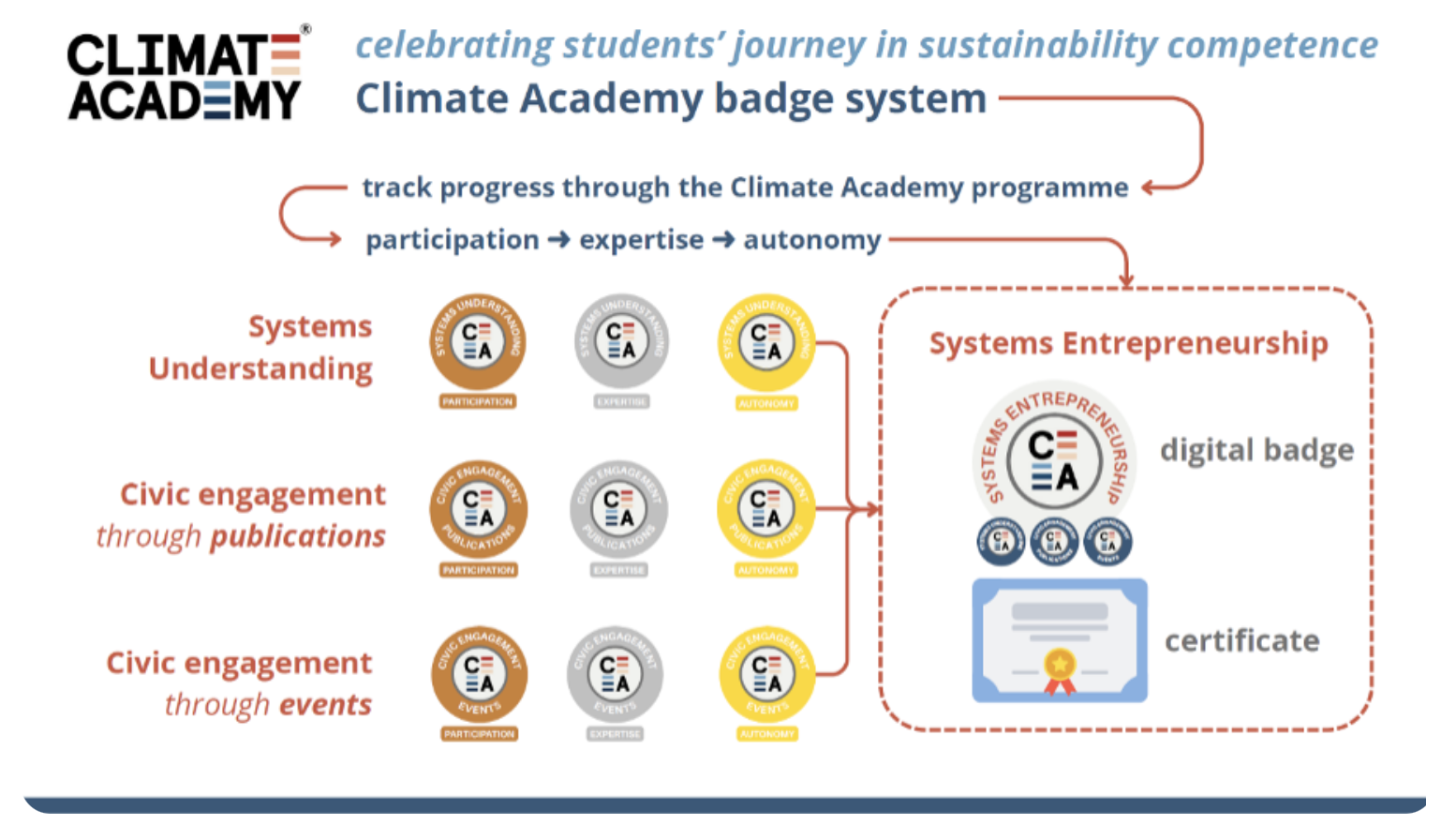
Any achievements in the Climate Academy programme are therefore of significant value. Our certificates demonstrate genuine depth of understanding and agency.
Fundamental structure of the certificates
There are four levels of certification for each of the Climate Academy pillars.
1. Bronze. Participation
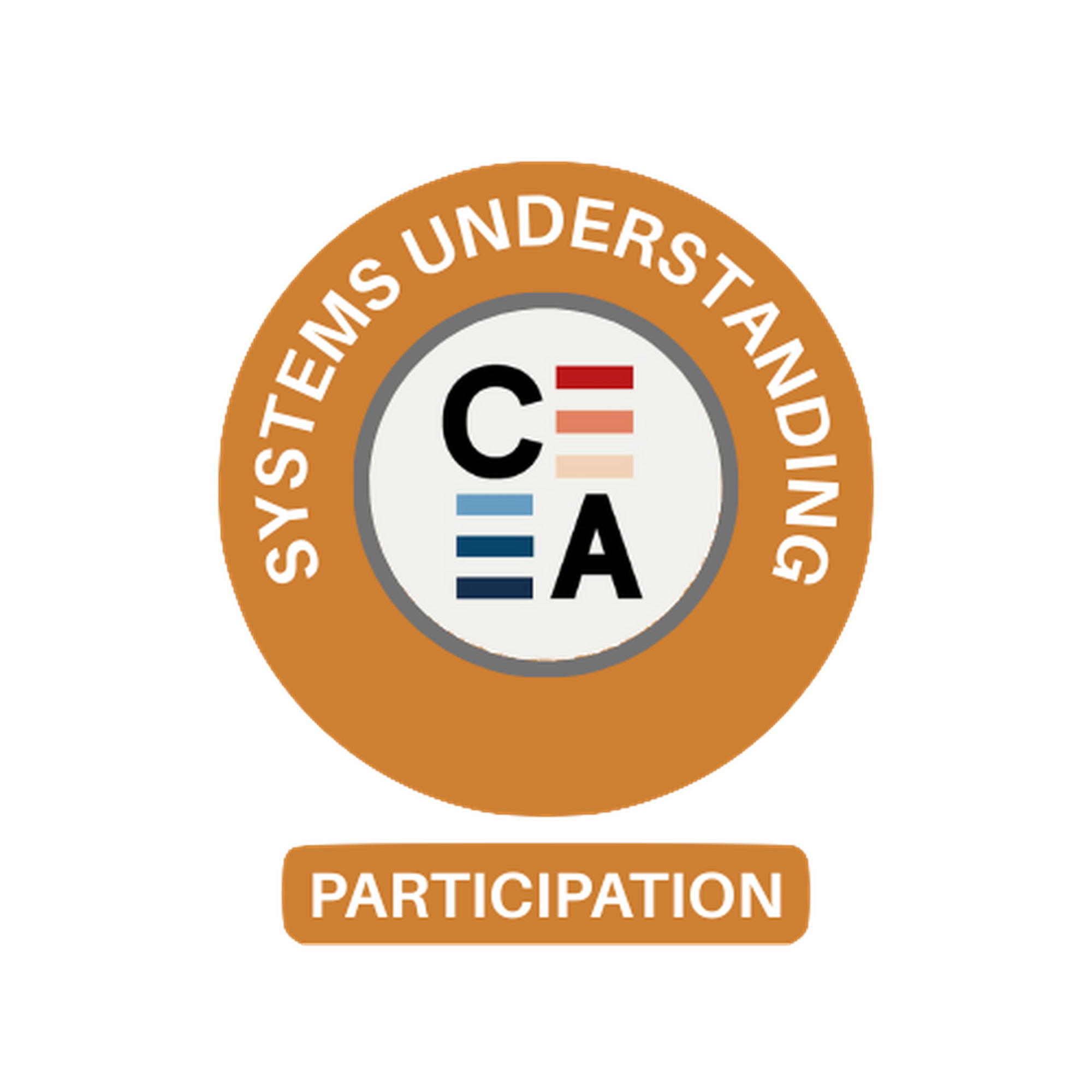
You engage in the Climate Academy material.
Engagement in this material is significant because it is:
* framed by planetary boundaries
* explores the crisis from a 360° systems vantage point
* informed by issues of global justice
2. Silver. Expertise
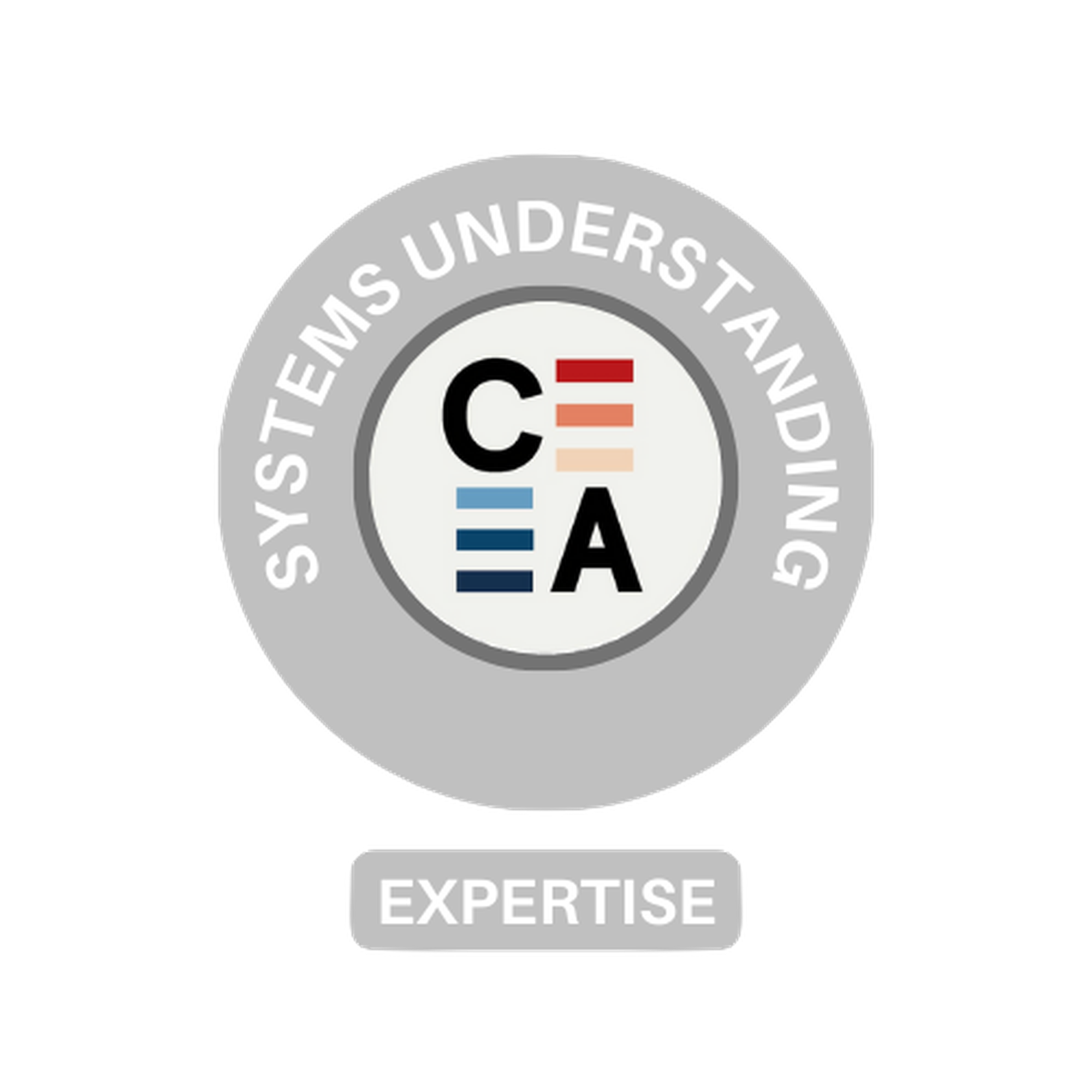
Going deeper. An active use of this material in either a presentation, publication, or event advances and sharpens your understanding. At this level, your work is likely to have an impact beyond your school, as it typically features a publication or event of particular quality and depth.
3. Gold. Autonomy
This is a level well beyond participation. Here, you take the initiative to mobilise others to understand and engage at a systems level. This could be by setting up a Climate Academy or by managing a Climate Academy project.
4. Platinum. Leadership
At this highest level of achievement, your Climate Academy work will typically be marked by a deep recognition of intersectional issues, overcoming significant personal or social barriers, or perhaps carrying a clearly valuable legacy.