Pillar 1 : Systems Understanding - (SILVER AWARD)
 |
 |
Overview
Systems Understanding – Silver
Detailed pathway requirements
Read the detailed requirements below, then select the pathway you intend to follow.
Examples and ideas
The examples below are intended to help you imagine how either pathway might be achieved. They are not additional requirements.
Teaching Pathway — examples
Teaching is a powerful way to deepen your own understanding. Choose a topic that interests you and help another group understand not only the facts, but also how the issue fits into the wider sustainability system.
Possible teaching settings
If you are a school or university student, your session might happen in a lesson, seminar, club or with a younger group. A teacher might use the pathway to develop and deliver a new learning activity. A lifelong learner could work with colleagues, friends, family, a community group or a local organisation.
- Geography: tipping points and how close they are.
- Economics: limits to growth and the paradox of innovation.
- Physics or Chemistry: carbon budgets and why they matter.
- Psychology: motion blindness, status quo bias and climate awareness.
- Sociology, History, Literature, Ethics or Religion: communication, social tipping points, climate anxiety or justice.
- A workplace or professional group.
- A community, hobby or social group.
- A local NGO concerned with environment or social justice.
- Friends or family who would value a clear explanation of a topic.
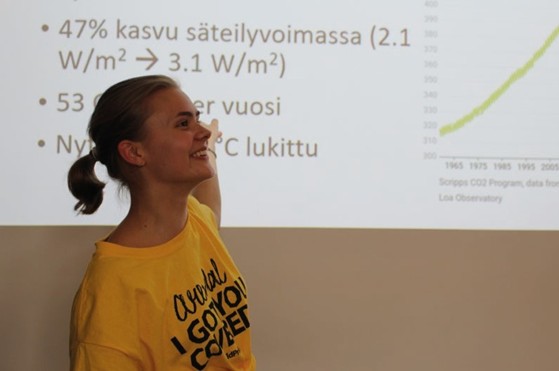
A real example — Vappu Väänänen
Vappu Väänänen, working with the Climate Academy in Brussels in 2019, gave a presentation to her mother's Tuesday evening knitting group. Her session used the latest science on carbon budgets and explored how Global North consumerism contributes to pressure on planetary boundaries. The example shows that the audience does not need to be formal or academic; what matters is that you communicate a deeper, systems-informed understanding clearly and meaningfully.

Research Pathway — examples
This pathway gives you room to investigate a topic in depth and reflect on how your understanding changed as a result.
Choosing your research topic
You might follow up a chapter from the Student Book that particularly interested you, using books, documentaries, research papers, lectures or other reliable material. Or you might investigate an issue not covered in depth by the book — for example biodiversity loss, agriculture, battery technology or carbon capture.
The subject can vary widely, but your analysis should still connect back to the wider sustainability system rather than treating the topic in isolation.
Questions to guide your reflection
- Why did this issue attract your attention?
- How did the research advance your understanding?
- How did it confirm or challenge what you previously thought?
- How well did the material recognise planetary boundaries and the wider systems context?
- Where relevant, how did the CUTx Index sharpen or challenge the way the issue was presented?
Share what you discovered
Your research is not meant to remain private. Share your conclusions with a trusted group, teacher, colleague, friend or other suitable audience. The purpose is to demonstrate that you can explain what you learned, how your thinking developed, and how the topic connects to the broader systems framework.
Chapter-by-Chapter Support
Explore chapter-by-chapter prompts, discussion topics and key questions to help you choose a topic, shape your content, lead discussion or frame an activity for your teaching session.
Pick your chapter, pick your angles, and build from there.
Chapter-by-Chapter SupportYour next step
Once you have selected the pathway you intend to follow, continue to the Evidence Requirements page. That next page explains how to demonstrate that you have met the requirement selected here.